
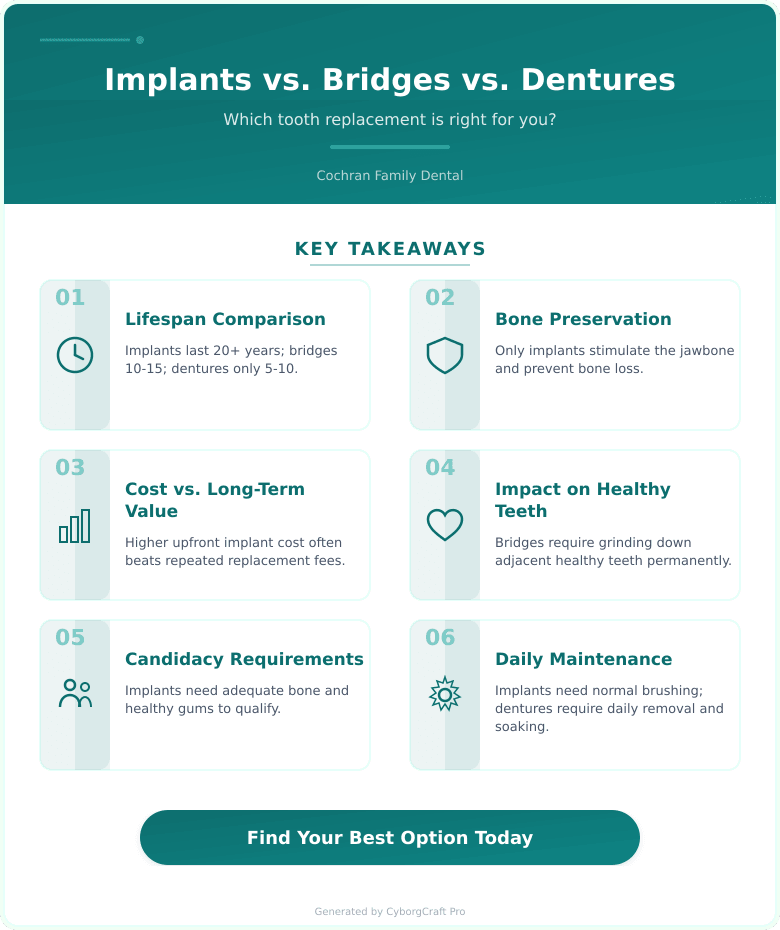
Dental implants vs. dentures vs. bridges is a comparison of the three primary tooth replacement options available to adults who have lost one or more teeth. Each option carries distinct differences in cost, longevity, comfort, and candidacy requirements that make one choice significantly better than another depending on your situation.
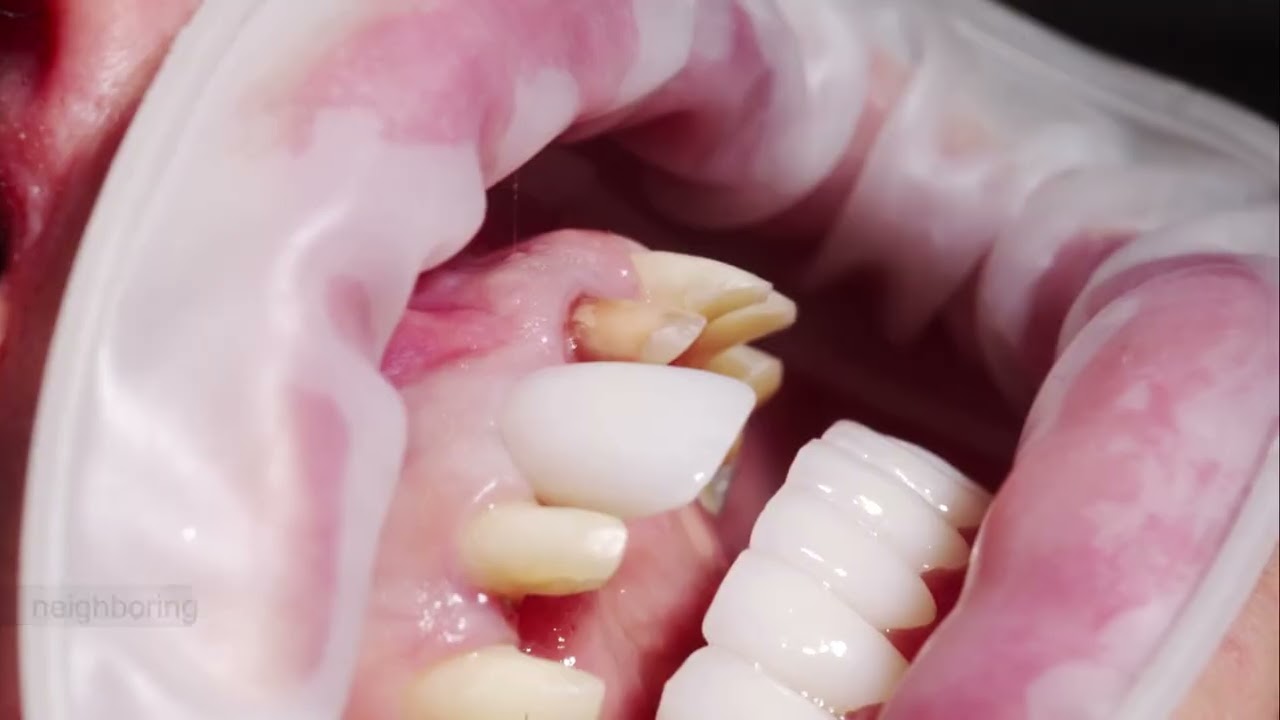
This guide focuses specifically on helping Leesburg-area patients understand which tooth replacement option fits their health profile, budget, and long-term goals.
Tooth Replacement Definition: Dental tooth replacement encompasses restorative procedures – implants, dentures, and bridges – used to restore function and appearance after tooth loss, each varying in procedure complexity, cost, and permanence.
Tooth loss affects more adults than most people realize. According to the National Institute of Dental and Craniofacial Research, a significant portion of American adults are missing at least one tooth. The most common mistake patients make is choosing based on upfront cost alone without factoring in long-term maintenance, bone health, or how the option affects neighboring teeth. At Cochran Family Dental, we see this pattern regularly, and it almost always leads to regret down the road.
What Each Option Actually Is
Dental implant: A titanium post surgically placed into the jawbone that fuses with bone tissue (osseointegration) and supports a permanent crown on top.
Dental bridge: A fixed prosthetic that spans a gap between teeth by anchoring to the healthy teeth on either side, called abutment teeth, which must be ground down to support the bridge.
Dentures: Removable appliances – either full (replacing all teeth) or partial – that rest on the gum line and are held in place by suction, clasps, or dental adhesive.
Dental Implants vs. Dentures vs. Bridges: Side-by-Side
| Feature | Implants | Bridges | Dentures |
|---|---|---|---|
| Average cost (2025) | Higher upfront cost per tooth | Moderate upfront cost | $1,000-$3,500 |
| Lifespan | 20+ years (often lifetime) | 10-15 years | 5-10 years |
| Bone preservation | Yes – stimulates jawbone | No | No – causes bone loss |
| Adjacent teeth affected | None | Yes – must be filed down | Minimal |
| Maintenance | Brush and floss normally | Special flossing required | Daily removal, soaking |
| Insurance coverage (2025) | Limited, often 0-50% | Partial, often 50% | Partial, often 50% |
| Best for | Single or multiple teeth, long-term investment | 1-3 missing teeth with healthy neighbors | Full arch or budget-limited cases |
Cost ranges reflect general industry averages in 2025. Actual fees vary by provider and clinical complexity. These figures are not the fees of any specific dental office.
Implants vs. Bridges: Which Approach Works?
Where implants succeed: Implants preserve bone density, never require grinding down healthy neighboring teeth, and function identically to natural teeth. For patients with a single missing tooth or multiple gaps in different areas, they are the most structurally sound long-term solution.
Where implants fail: Implants require adequate bone volume and healthy gums. Patients with uncontrolled diabetes, active gum disease, or significant bone loss may not qualify without bone grafting first. The upfront cost is the highest of the three options, and the full process takes 3-9 months.
Where bridges succeed: A bridge can restore a missing tooth faster – often within 2-3 weeks – and at a lower initial cost than an implant. Insurance plans typically cover a portion. For patients who want a fixed (non-removable) solution without surgery, bridges are a reasonable alternative.
Where bridges fail: Bridges require permanently altering two healthy teeth. They do not prevent bone loss in the gap area. After 10-15 years, replacement is usually necessary, meaning additional cost and another round of prep work on adjacent teeth.
The verdict: For most patients missing one or two teeth who have adequate bone health, implants deliver better long-term value despite the higher upfront cost. Bridges are a practical option when implant candidacy is limited or when timeline and cost are the deciding factors.
Thinking about which option fits your situation? Let’s talk. Contact us and we’ll walk you through your options with no pressure and no jargon.
Where Dentures Fit In
Dentures get a bad reputation, but for patients replacing an entire arch of teeth, they remain a practical and affordable starting point. Full dentures typically run $1,000-$3,500 for a complete set (2025 general industry range). Implant-supported dentures, which snap onto 2-4 implants for stability, bridge the gap between traditional dentures and full-mouth implants and represent a significant investment that varies based on clinical complexity and provider.
The honest drawback: traditional dentures accelerate bone resorption because there is no root stimulating the jaw. Over time, the fit loosens and refitting or replacement becomes necessary. The American Dental Association notes that bone loss under dentures is a documented long-term concern worth discussing with your dentist before committing.
Your Tooth Replacement Decision Checklist
- Step 1 – Confirm bone health: A CBCT (cone beam CT) scan reveals whether you have enough bone volume for implants or require grafting first.
- Step 2 – Assess neighboring teeth: If adjacent teeth are already compromised, a bridge may serve double duty. If they are healthy, protecting them from grinding favors an implant.
- Step 3 – Review insurance coverage: Check your 2025 plan details. Many policies cover bridges and dentures at 50% after deductible. Implant coverage is improving but still inconsistent.
- Step 4 – Calculate total cost over 10 years: An implant that lasts 20 years often costs less over time than a bridge replaced twice in the same period.
- Step 5 – Consider your lifestyle: Active patients, athletes, or anyone uncomfortable with removable appliances will find implants or bridges easier to manage daily.
Pre-Appointment Preparation
- ☐ Gather your current dental insurance card and benefit summary
- ☐ List all medications including blood thinners and diabetes medications
- ☐ Note any history of gum disease, bone loss, or jaw surgery
- ☐ Write down how long the tooth has been missing (impacts bone loss assessment)
- ☐ Bring previous dental X-rays if available
Key Takeaways for Leesburg Patients in 2025
- Implants preserve bone – the only option that stimulates the jawbone and prevents long-term facial structure changes
- Bridges are faster – fixed in place within weeks, but require altering healthy teeth and do not stop bone loss
- Dentures are most affordable upfront – best for full-arch replacement, though long-term fit and bone loss require monitoring
- Total cost over time matters more than sticker price – factor in replacements and maintenance when comparing
- Candidacy varies – bone volume, gum health, and systemic conditions all influence which option is safe and effective for you
This content is for educational purposes only and does not substitute for professional dental evaluation. Always consult a licensed dental professional for personalized treatment recommendations.
Frequently Asked Questions
How much do dental implants cost without insurance in 2025?
A single dental implant carries a higher upfront cost than other tooth replacement options, with the total varying based on the post, abutment, and crown. Costs vary based on bone grafting needs, geographic location, and the materials used. These are general industry ranges, not the fees of any specific dental practice.
Are dental bridges covered by insurance?
Most dental insurance plans cover bridges at 50% of the allowed benefit after your deductible, subject to annual maximums. Coverage details depend on your specific plan. Review your 2025 benefit summary or call your insurer before scheduling treatment.
How long does the dental implant process take?
The full implant process typically takes 3-9 months from placement to final crown. Healing after the post is placed takes 3-6 months. Patients who need bone grafting before implant placement should expect the process to extend further.
Can dentures be converted to implants later?
Yes – many patients start with traditional dentures and later transition to implant-supported dentures as budget allows. However, extended time in traditional dentures accelerates bone loss, which can complicate implant placement later. Discussing a phased plan with your dentist early is worthwhile.
Does getting a dental implant hurt?
Most patients report that implant surgery is less uncomfortable than expected, with local anesthesia controlling pain during the procedure. Post-surgical soreness typically peaks at 2-3 days and is manageable with over-the-counter pain relief. Significant pain beyond the first week warrants a follow-up call to your dentist.
Which tooth replacement option lasts longest?
Dental implants have the longest documented lifespan, with well-maintained implants lasting 20 years or more – often a lifetime. Bridges typically last 10-15 years and dentures 5-10 years before replacement or relining is needed.
The Bottom Line for Leesburg Patients
There is no single right answer for every patient. The best tooth replacement option depends on your bone health, the number and location of missing teeth, your insurance coverage, and your honest budget over the next 10-20 years – not just today.
Patients throughout Leesburg, Ashburn, Sterling, Purcellville, and the broader Loudoun County area have access to the full range of these options. Getting an honest, unhurried evaluation is the most important first step.
Ready to find out which option makes sense for your mouth? Contact Cochran Family Dental to schedule a consultation. We’ll review your X-rays, walk through your options clearly, and give you a straight answer – not a sales pitch. You can also explore our smile enhancement services if you’re considering a broader smile refresh alongside tooth replacement.