
A chipped or broken tooth is a dental injury where part of the tooth’s enamel, dentin, or root structure fractures or breaks away. Acting quickly in the first few hours significantly reduces pain, infection risk, and the chance of losing the tooth entirely.

This guide focuses specifically on the immediate steps to take after chipping or breaking a tooth, including what to do at home, when to call your dentist, and what treatment options are available.
Broken Tooth Definition: A broken or chipped tooth is any fracture to the tooth structure – ranging from a small surface chip to a deep crack reaching the root – that requires professional dental evaluation to prevent further damage or infection.
The most common mistake people make after a tooth breaks is waiting too long to act. A small chip can feel minor, but what you can’t see is whether the inner pulp is exposed. That’s where real problems begin. Dental injuries are widely recognized by dental health professionals as a significant and common concern. The good news is that most broken teeth can be saved with prompt care.
What Happens When a Tooth Breaks
Not every broken tooth looks the same. Some chips are barely visible. Others involve serious structural damage. Understanding the type of break helps set the right expectations before your appointment.
- Minor enamel chip – surface only, usually painless
- Fractured cusp – the chewing surface breaks, often around a filling
- Cracked tooth – extends from the surface toward the root, may cause sharp pain
- Split tooth – the tooth separates into segments, often not salvageable
- Vertical root fracture – starts at the root, may show few symptoms until infection sets in
Cracked Tooth Syndrome: A condition where a crack in the tooth causes inconsistent pain during chewing or with temperature changes, often difficult to diagnose without clinical examination.
If you feel sharp pain when biting down, or sensitivity that lingers more than a few seconds after eating something cold, the crack likely extends deeper than the enamel. That’s a signal to call your dentist the same day – not next week.
Your Broken Tooth Action Plan
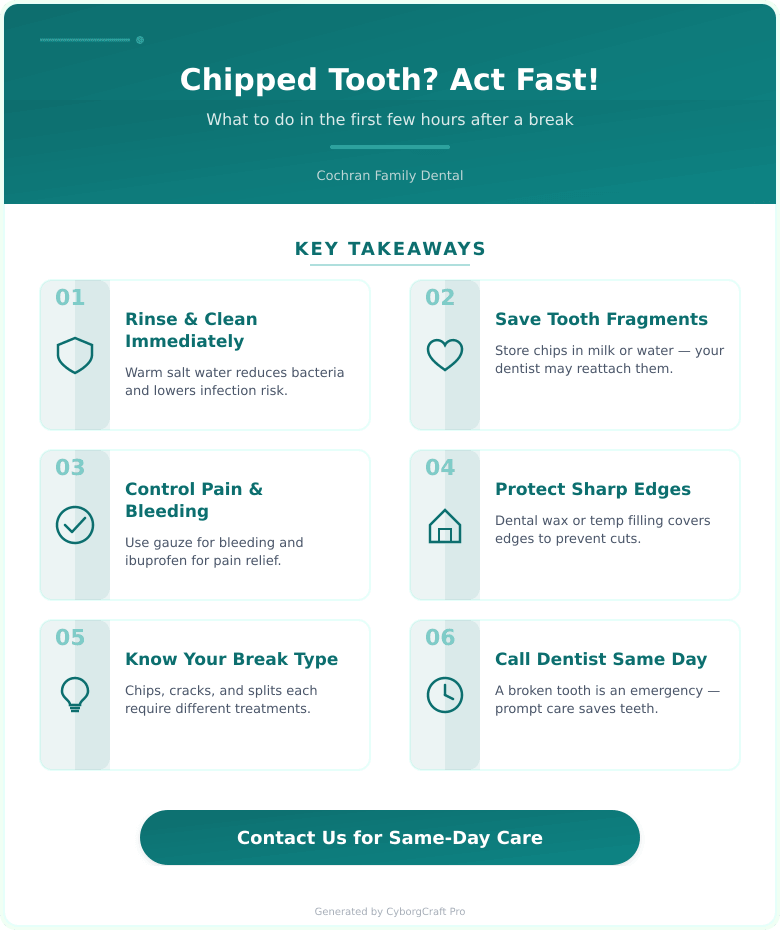
- Step 1 – Rinse your mouth: Use warm salt water to clean the area and reduce bacteria around the break. This lowers the risk of infection before you reach the dentist.
- Step 2 – Save any tooth fragments: Place chips or pieces in a small container with milk or clean water. Your dentist may be able to reattach them.
- Step 3 – Control bleeding: Apply gentle pressure with clean gauze. If bleeding doesn’t slow within 15 minutes, call your dentist immediately.
- Step 4 – Protect the tooth: Use over-the-counter dental wax or temporary filling material (available at most pharmacies) to cover sharp edges that could cut your tongue or cheek.
- Step 5 – Manage pain: Take an over-the-counter pain reliever like ibuprofen as directed. Avoid placing aspirin directly on the gum – it can cause tissue damage.
- Step 6 – Call your dentist right away: A chipped or broken tooth is a dental emergency. Contact us to schedule a same-day or next-day appointment so we can assess the damage before it gets worse.
Thinking about this for your situation? Let’s talk. We’ll walk you through your options – no pressure. Reach out to Cochran Family Dental and we’ll help you figure out the next step.
Chip vs. Crack: Which Approach Works?
Where a chip succeeds as a simple fix: Chips limited to the enamel layer are often treated with dental bonding in a single visit, at relatively low cost, with no recovery time needed.
Where a chip falls short: If the chip extends into the dentin or exposes the pulp, bonding alone won’t solve the problem. Root involvement changes the treatment path entirely.
Where a crack requires more attention: Cracks that reach the pulp often call for a root canal (endodontic therapy) followed by a crown to protect what remains of the tooth structure.
Where cracks become complicated: Vertical root fractures or splits that extend below the gumline may leave extraction as the only viable option.
The verdict: A chip caught early is almost always fixable in one appointment. A crack that’s been ignored for weeks may require multi-visit treatment or tooth replacement. Speed matters.
| Injury Type | Typical Treatment | Estimated Cost Range (2025) | Timeline |
|---|---|---|---|
| Minor enamel chip | Dental bonding | $100 – $400 | 1 visit |
| Fractured cusp | Crown or onlay | $800 – $1,700 | 1-2 visits |
| Cracked tooth | Root canal + crown | $1,200 – $2,500 | 2-3 visits |
| Split or vertical fracture | Extraction + implant or bridge | $1,500 – $4,500 | Several weeks |
Cost ranges above reflect general 2025 industry averages and are not specific to any single provider’s fees. Actual costs vary by location, complexity, and insurance coverage.
What Your Dentist Will Do at the Appointment
Expect a thorough clinical exam, digital X-rays, and possibly a visual bite test to locate the exact crack line. Based on what the imaging shows, your dentist will walk you through the most appropriate path forward.
According to the National Institute of Dental and Craniofacial Research, untreated dental injuries can progress to pulp infection and abscesses – which are significantly more expensive and painful to treat than the original injury.
At Cochran Family Dental in Leesburg, VA, the focus is on catching the full extent of the damage before recommending a treatment path. A quick look in the mirror won’t reveal a vertical fracture. Clinical tools will.
Want to explore your treatment options first? Visit our services page to see the full range of care available at our office, or learn more about how we approach restorative work.
Key Takeaways for Leesburg Patients in 2025
- Act within hours, not days – delay increases infection risk and treatment complexity
- Save any broken fragments – store in milk and bring them to your appointment
- Pain is a warning sign – lingering sensitivity likely means pulp involvement
- Not all chips need a crown – small surface chips can often be repaired with bonding in one visit
- Insurance often covers emergencies – call your provider to confirm coverage before your appointment
Frequently Asked Questions
How quickly should I see a dentist after chipping a tooth?
Same-day or next-day care is strongly recommended after any tooth fracture. Even a chip that doesn’t hurt could expose the inner tooth to bacteria, and delays allow damage to progress further.
Can a broken tooth heal on its own?
No – teeth cannot regenerate or self-repair once the structure is fractured. Without treatment, the crack can deepen, bacteria can reach the pulp, and what started as a simple repair can become a root canal or extraction.
Does a chipped tooth always require a crown?
Not always – small enamel chips are frequently repaired with tooth-colored bonding resin in a single appointment. Crowns are typically recommended when a large portion of the tooth breaks or when the damage compromises structural integrity.
Is a broken tooth covered by dental insurance?
Many dental insurance plans cover a portion of emergency restorative care, depending on your specific plan and deductible. Bonding may be covered at 50-80%, while crowns often fall under major restorative coverage at 50% after deductible. Always call your insurer before your visit.
What if I broke a tooth and there’s no pain?
No pain doesn’t mean no problem – a painless break can still expose dentin or create an entry point for infection. Current best practices in 2025 recommend evaluation regardless of symptoms, especially if the break affects a back molar or involves an existing filling.
How long does dental bonding last on a chipped tooth?
Dental bonding typically lasts 5-10 years with proper care before needing touch-up or replacement. Avoiding biting hard objects and maintaining regular cleanings extends bonding longevity significantly.
When is a broken tooth a dental emergency?
Seek emergency dental care immediately if you experience uncontrolled bleeding, severe pain, swelling, or if a large portion of the tooth is missing. Signs of infection – such as fever, swelling in the jaw, or pus – require same-day treatment without exception.
Ready to get your tooth looked at? Contact Cochran Family Dental today and we’ll get you in as quickly as possible. A broken tooth doesn’t wait – and neither should you.
Disclaimer: This content is for informational purposes only and is not a substitute for professional dental advice. If you are experiencing severe pain, swelling, or a dental emergency, please contact your dentist or an emergency dental provider immediately.